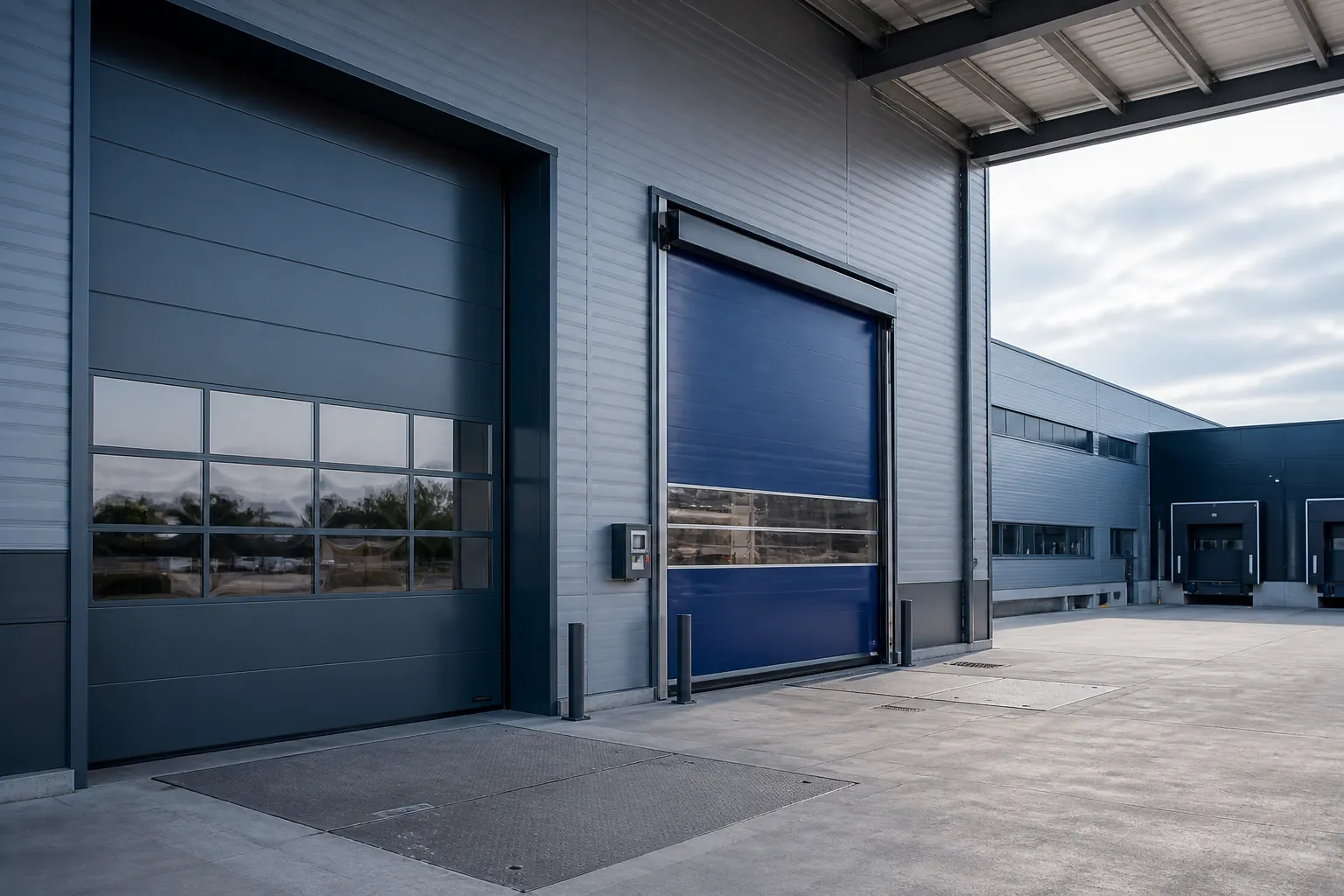
Sectional door construction
Hinged panels travel through side tracks and turn beneath the roof or follow another engineered lift path. Insulated panels can help manage internal conditions, while windows and personnel doors may be added where the door design permits.
Industrial and logistics applications
Factories and warehouses use sectional doors at dispatch bays, vehicle entrances and internal divisions. Motor duty, hardware and safety equipment must reflect the daily cycle count and the presence of forklifts or other traffic.
Lift type and site survey
Lintel height, side room, roof services and floor level determine whether standard, high or vertical lift is appropriate. Accurate measurements also support spring calculation, track layout and operator selection.
Safety and commissioning
Door balance, cables, springs, travel limits and safety inputs are tested after assembly. Because springs and lifting cables store or carry substantial energy, adjustment and replacement are specialist tasks.
Service and upkeep
Uneven movement, slack cables, damaged panels or unusual track noise require prompt assessment. Maintenance should cover both mechanical lifting components and the operator, controls and protective devices.
Send dimensions and photographs for Sectional Doors
Share the site, opening dimensions and expected use so we can clarify suitable equipment and installation scope.
Frequently asked questions
What to know about Sectional Doors
How does a sectional door differ from a roller shutter?+
A sectional door follows tracks in connected panels, while a roller shutter coils its slats around a barrel.
Can one fit an existing opening?+
It may, provided the lintel, side clearances, structure and overhead services allow a suitable track arrangement.
Is an insulated sectional door airtight?+
Insulated panels reduce heat transfer, but overall performance also depends on seals, installation and building conditions.
Can a door be used with a broken spring or cable?+
No. Stop operating it and arrange a qualified inspection because the door may be unbalanced.